
Shin Splints, Training Load, and How to Come Back Without It Returning
7 minute read · Written by Phil McComiskey, HCPC CH34450
Almost every case of shin splints we see has the same story behind it. Something changed in training, and the change was bigger or faster than the leg was ready for. The pain is in the shin. The cause is almost always in the training diary.
What is actually happening
Shin splints is the everyday name for medial tibial stress syndrome. It is stress on the bone along the inside border of the tibia, and on the tissue attached to it, caused by repeated loading. It is not a single structure failing. It is a region of the leg being worked harder than it is currently built to tolerate.
Bone does adapt to load, and it adapts well, but it adapts slowly. That is the whole problem in one sentence. It also sits on a spectrum. At the mild end it is an irritation that settles quickly once the load comes down. At the other end, if it is trained through for long enough, it can progress towards a bone stress injury, which is a very different conversation and a much longer one.
The change that usually caused it
The triggers are remarkably consistent. A jump in weekly mileage. The start of a new training block. Adding faster running or hill work. A change of surface from grass or treadmill to concrete or track. Shoes that are past their useful life. A return to running after time off, at the volume you were doing before you stopped rather than the volume you can currently handle.
The general principle behind all of those is the same. Muscle and cardiovascular fitness improve faster than bone remodels, so it is entirely possible to feel fit and capable while your shins are quietly falling behind. People often tell us the running felt easy. That is usually true, and it is also why the increase went unnoticed.
Shin splints or a stress fracture
Shin splints typically produces a broad ache or burn along the inside of the shin, spread over several centimetres rather than one point. It comes on during a run, often at a predictable distance, and settles within minutes of stopping. Both legs are affected in many cases.
A stress fracture behaves differently. The pain is usually sharper, and it sits over one specific point you can cover with a fingertip. It tends to come on earlier in a run and stay for longer afterwards. It can hurt at rest, and it can wake you or ache at night. It usually gets worse week by week rather than better.
If your pain fits that second description, please get it assessed promptly rather than training through it. That is the one situation where continuing to run genuinely makes things worse, and where the difference between acting early and acting late is measured in months.
Why rest alone lets it come back
Rest works, in the narrow sense that it settles the symptoms. What it does not do is change how much load your leg can tolerate, or change the mechanics and the footwear that were sending that load through the shin in the first place. So when you go back to the same training you were doing when it started, the same thing happens, because nothing about the equation has changed except that you have had a few weeks off.
What we look at
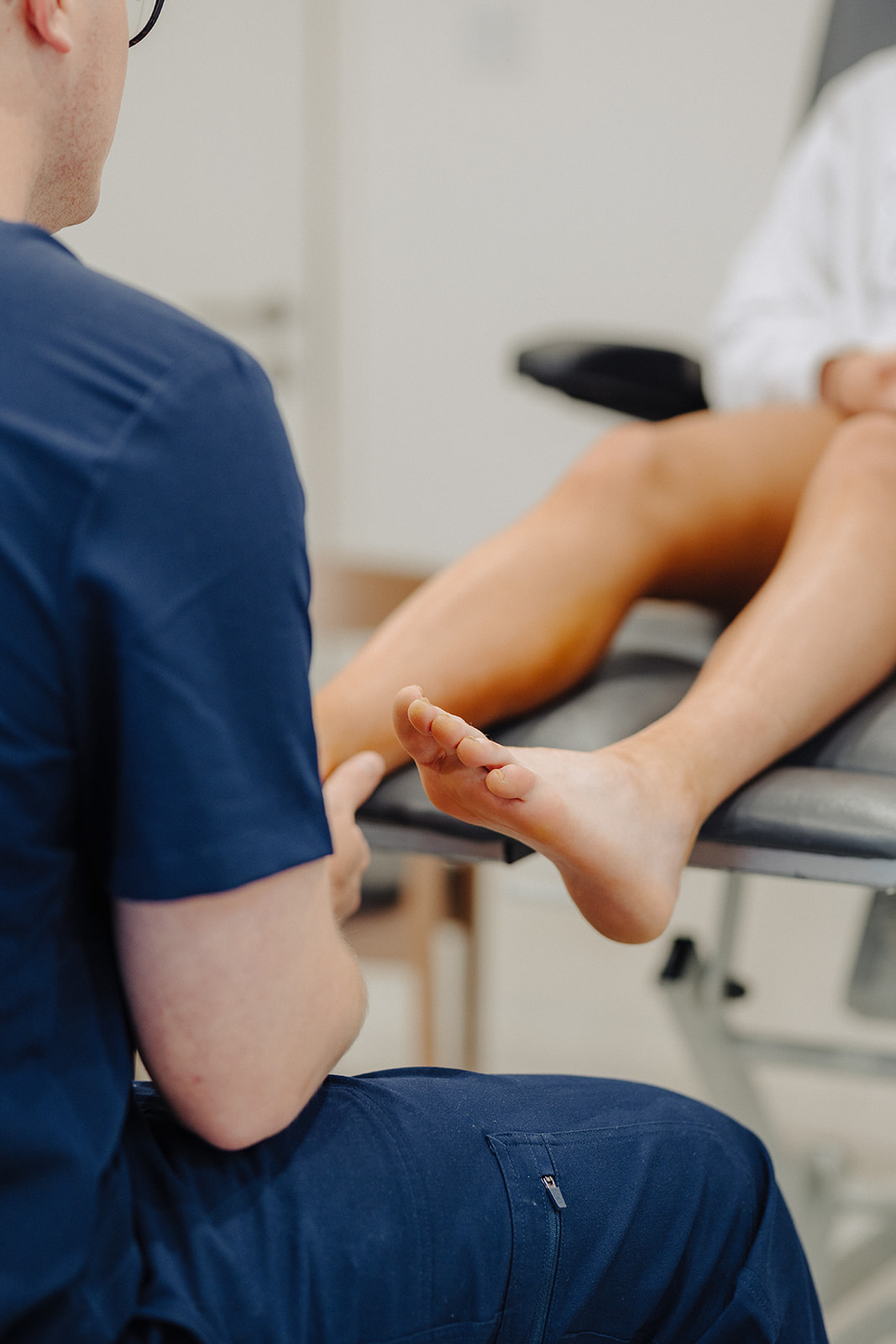
The assessment starts with the training history, in detail, because that is usually where the answer lives. Then we examine the leg to work out what is irritable and where, check your calf and foot function, and look at the shoes you are actually running in rather than the ones you own. We use video gait analysis on the treadmill and Footscan pressure analysis to see how load is arriving at the foot and travelling up the leg, which is the part you cannot work out by feel.
Coming back without it returning
The rebuild starts from a level the bone currently tolerates, not the level you were at when it started hurting. In most cases that means running less rather than not at all, and adjusting surface, frequency and intensity as well as distance. Finding that starting level honestly is the single most useful thing you can do.
From there the increases are gradual, and the thing to monitor is not how the shin feels during the run. It is how it feels over the following twenty four hours. A shin that is quiet during a run and sore the next morning is telling you the step up was too big, and that is much more useful information than anything you notice mid run.
Alongside that, calf, hip and foot strengthening builds the capacity that stops it recurring, and footwear changes reduce what the shin has to absorb in the first place. Where the gait data shows how your foot loads is a real part of the problem, orthotics can change that too. Most runners do not need everything on that list, but almost nobody gets away with doing none of it.
Want yours looked at?
A Foot, Heel and Lower Limb Pain Assessment at Assure Health is £120 for 60 minutes, and includes a hands on assessment of the leg alongside video gait analysis and Footscan pressure analysis, so we can see how load is reaching your shin.
Book an AssessmentClinically reviewed by Phil McComiskey, Clinical Director and Podiatrist, HCPC CH34450. Last reviewed September 2026.
Ready to move better?
Book online in under a minute. Same week appointments available.