
What Causes Bunions, and Do Shoes Really Cause Them?
5 minute read · Written by Phil McComiskey, HCPC CH34450
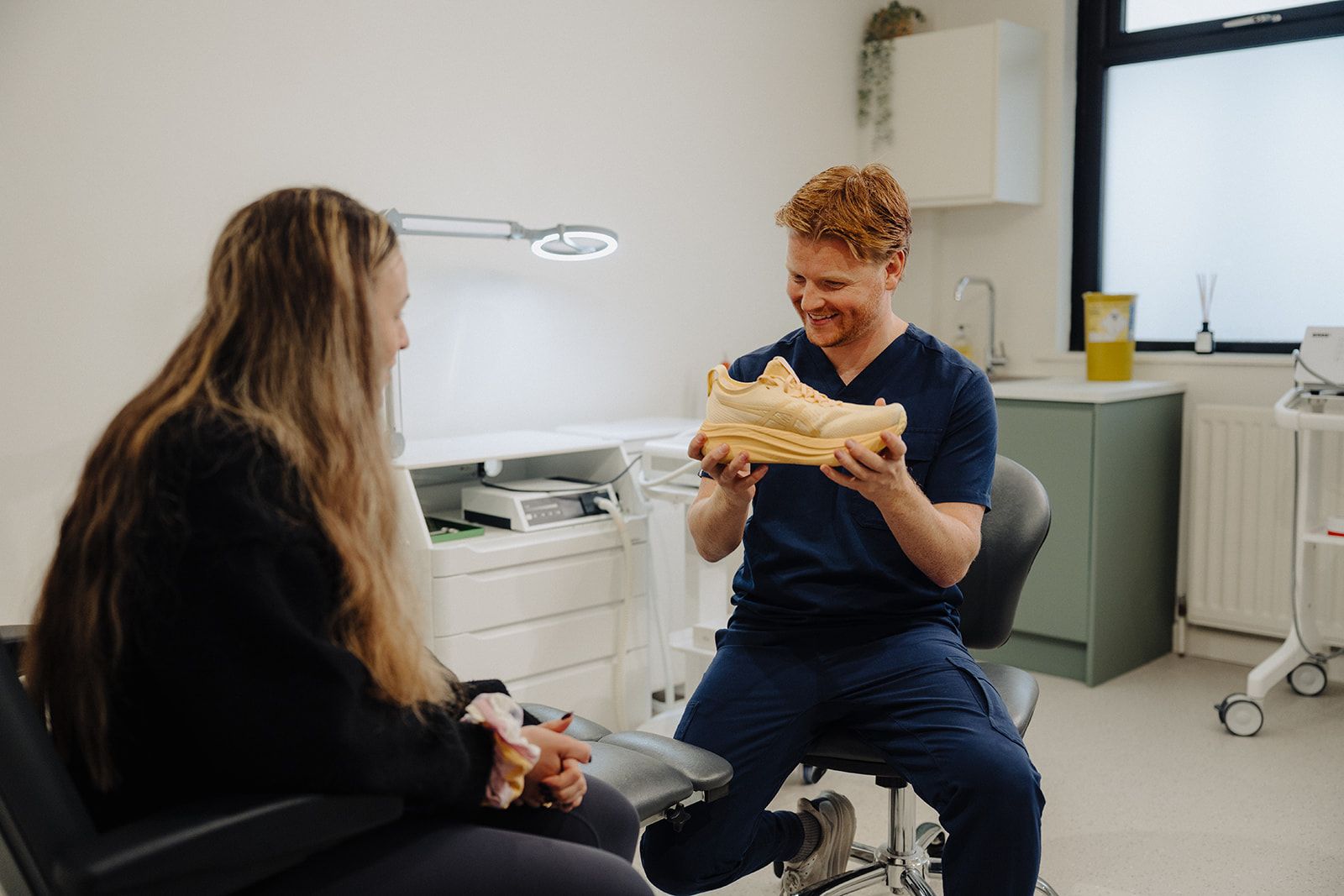
Almost everyone who comes into the clinic with a bunion tells us the same thing, which is that their shoes caused it. It is one of the most common beliefs we correct, and the truth is more interesting and a good deal more useful.
Bunions are largely inherited
The medical name for a bunion is hallux valgus. The big toe gradually drifts towards the second toe, and as it does, the long bone behind it pushes the other way. The bump you can see on the inside of your foot is that bone becoming prominent, not new bone growing.
Research consistently shows that the main factor is inherited. What you inherit is the shape and mechanics of your foot. If a parent or grandparent had bunions, your risk is significantly higher. An inherited foot shape, a mobile first ray or a flatter foot type all change how force passes through the big toe joint.
So do shoes matter at all?
Yes, but not in the way most people think. Narrow or pointed shoes, high heels and a lot of time on hard surfaces all increase pressure through a joint that is already changing. They make an existing bunion more painful and can speed up how quickly it progresses. Current evidence treats footwear as something that aggravates a bunion rather than something that causes one.
This matters, because it changes what you do about it. Changing your shoes will not undo a bunion. It can make a very real difference to how much it hurts, which for most people is the thing they actually care about.
Why pain and appearance do not match
One of the most useful things we can tell patients is that the size of a bunion is a poor guide to how much it will hurt. Research looking at adults with hallux valgus has found that the angle of the deformity, and even the presence of arthritis in the joint, do not reliably predict pain levels. Plenty of people have large bunions and very little pain. Others have modest ones that ache every day.
What does matter is how load is passing through the foot. As the joint drifts, the big toe stops taking its normal share of force when you push off. That load has to go somewhere, so it transfers across to the second and third toes. This is why so many people with bunions describe aching or burning under the ball of the foot, and why hard skin builds up there. The bunion is the visible part. The load transfer is what is generating a lot of the pain.
There is also a measurable loss of strength in the muscles that control the big toe in people with bunions. That is part of why treatment aimed at load, footwear and strength can reduce pain considerably even though the shape of the joint has not changed at all.
Do bunion correctors and splints work?
Bunion correctors, splints and toe spacers are sold heavily online with before and after photographs. They can be genuinely useful for comfort, because separating the toes overnight can ease a sore joint and reduce rubbing. What they cannot do is realign the bones.
The reason is simple. Hallux valgus is a change in the structure and alignment of a joint, held there by bone shape, ligaments and the pull of tendons across it. A soft strap worn for a few hours cannot reverse that any more than a splint could straighten a curved spine. Any change you see disappears within minutes of taking it off.
We are not against them. If a spacer makes your foot more comfortable, wear it. We would just rather you bought it knowing what it does, which is manage symptoms, rather than believing it will fix the problem.
What actually helps
Only surgery corrects a bunion. Everything else is about controlling symptoms and slowing progression, and for the large majority of people that is genuinely enough. Most patients we see never need an operation.
The things that make the biggest difference are the right footwear, work on the strength and control of the big toe and arch, and where your gait data shows it will help, custom orthotics that improve how force passes through the joint. None of these straighten the toe. All of them can change how much it hurts.
Want yours looked at?
A Foot, Heel and Lower Limb Pain Assessment at Assure Health is £120 for 60 minutes, and includes video gait analysis and Footscan pressure plate analysis so we can see exactly how load is passing through your big toe joint.
Book an AssessmentClinically reviewed by Phil McComiskey, Clinical Director and Podiatrist, HCPC CH34450. Last reviewed September 2026.
Ready to move better?
Book online in under a minute. Same week appointments available.